

 Their Satanic Majesties has been unfairly maligned over the fifty years it has existed, by fans, critics and the band who created it, The Rolling Stones. In my view it is a classic album which deserves to be held in the same esteem as the four albums which followed it and are universally regarded as the Stones’ ‘Golden Run’: Beggar’s Banquet; Let It Bleed; Sticky Fingers and Exile On Main Street.
It is easy for criticism to become received wisdom over the years and one bad review, reprinted by lazy critics and journalists, unable or unwilling to actually listen to an album and make up their own minds, can assume the mantle of fact. It is my intention to argue the case for Their Satanic Majesties Request, which I believe to be not only the equal of the albums in the Golden Run, but also of Sgt Pepper’s Lonely Hearts Club Band, often regarded as the high watermark of English psychedelia.
Satanic Majesties is not really a Stones album, the accepted position holds; it’s an aberration, a misfire, an ill-judged attempt to jump on the psychedelic bandwagon which Sgt Pepper had put into motion.
To understand the album you need to look at the time in which it was made. To enjoy it, you simply have to put it onto your record player and drop the needle! Or, of course, insert it into your CD player and press ‘Play’.
In 1967 the UK music scene had exploded into Technicolour, along with clothing fashions and graphic design. Paisley prints and bold, colourful designs were the order of the day and even people like Cilla Black released albums with psychedelic cover art. Everyone wanted in.
The driver of this new scene was LSD, with a little marijuana on the side; The Stones, like other bands including the Fab Four, tuned in and turned on. They had released Between The Buttons in early 1967 which featured several very psychedelic tracks and it could be argued that ‘Paint It, Black’, recorded as early as March 1966 and released in May of that year, was an overtly psychedelic song, with its sitar and Eastern scales. The Stones weren’t bandwagon jumping; they were right there in the vanguard.
Brian Jones, already unravelling due to his ingestion of drugs and his perception that the band he had started was being taken away from him, had become the experimenter in the Stones and had, as early as ‘Lady Jane’ and ‘Mother’s Little Helper’, been bringing increasingly exotic instruments into the studio to see what he could do with them. It’s no surprise, therefore, that Satanic Majesties bristles with unusual sounds and textures and heavily features the Mellotron, then in its infancy as a rock instrument.
Another oft-repeated claim is that there are only two songs on the album which are worth talking about; 2000 Light Years From Home and She’s A Rainbow. This is to entirely miss the point and to show an unawareness of the musical climate into which Satanic Majesties was finally released, in December 1967, after the summer flowers had wilted.
Engineer Glynn Johns, who basically took over production duties when Andrew Loog Oldham walked out, dismissed some of the tracks as ‘utter drivel’. I disagree. The tracks usually singled out for the most vitriolic attacks are ‘Sing This Altogether’ and its eight and a half minutes long reprise ‘Sing This Altogether (See What Happens). Stories abound of a box of percussion instruments being upended on the studio floor and the various stoned hangers-on being invited to grab something and shake or bang it. Experimentation was the order of the day in 1967 and The Stones were simply joining in.
Melodically and harmonically, Sing This Altogether is a great song. Dressed up in its psychedelic threads it becomes even greater, with its lyrics of optimism and free thinking. ‘Open our heads, let the pictures come’ is right in tune with the Spirit of ’67. It sets the scene for what is to follow. That the theme is restated and developed later in the album is another device in common usage in classical music which was beginning to seep into pop.
Between these two tracks we find three tracks often dismissed as having no weight or value in the Stones’ canon. Not true. ‘Citadel’ is propelled by a great riff from Keith, distinctive percussion from Charlie, and some lovely keyboard textures. It’s a great song by anyone’s standards, but it’s not a Blues song.
Next comes ‘In Another Land’, written and voiced by Bill Wyman and featuring a psychedelic tremolo effect on the voice. Having a different lead vocalist on a song was again true to the spirit of the day, and In Another Land ramps up the psychedelia with its haunting harpsichord, howling wind effects and detached backing vocals from Mick during the verses. Steve Marriot also sings on the chorus. Because Bill was in the studio on his own he laid down this track so people will say ‘it’s not really a Stones song at all’. It sounds just like a Stones song to me!
‘2000 Man’ is next and again features a strong riff from Keith, this time on acoustic guitar. It has a very unusual rhythmic feel supplied by Charlie’s drums and another great melody. The sudden switch in feel after the second verse is pure 1967.
Listen to music from the same period by Frank Zappa, The Grateful Dead, Jefferson Airplane and The Red Crayola and you will hear echoes of the ‘free-form freak-out which makes up the bulk of Sing This Altogether (See What Happens). It’s not the Stones as we know them but it’s never less than entertaining. The stereo version on headphones is a psychedelic experience which stands with anything released around the time by any of the aforementioned acts.
‘She’s A Rainbow’, which opened the original side two, is carried along by the superb piano playing of Nicky Hopkins and is as good a song as the Stones ever wrote. Never mind that they nicked the chorus line ‘She comes in Colours’ from the Love song of the same name.
Another pair of much-maligned tracks follow; the moody and atmospheric ‘The Lantern’ and the Eastern raga-rock of ‘Gomper’. I love both of these songs; if you can listen to them just as two pieces of period psychedelia and divorce the Rolling Stones of ‘Satisfaction’ from them, then you may just start to realise what a couple of gems they really are.
The segue from Gomper into ‘2000 Light Years From Home’ is one of the first truly terrifying moments in sixties psychedelia. Written by Mick whilst incarcerated after the notorious Redlands bust, this song perfectly captures the alienation, removal and sheer otherness of the experience which inspired it. For me it stands alongside any of the other much-lauded anthems of the day, including anything Pink Floyd, The Pretty Things, The Doors and The Beatles produced in this landmark year.
The closing track ‘On With The Show’ is another one which comes in for unfair criticism. Lampooning the gentlemen’s club culture still very prevalent in Soho and set to a curiously anachronistic soundtrack, On With The Show has its tongue very firmly in its cheek.
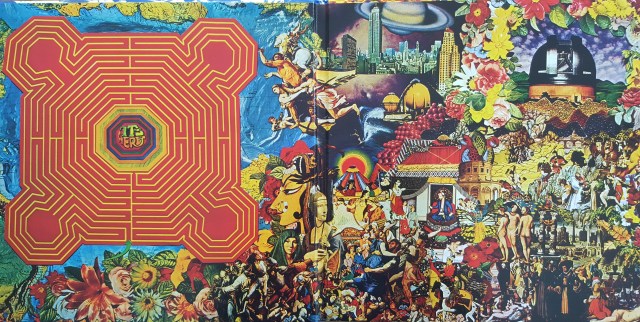
The cover art, featuring the lenticular picture on the front, again invites criticism of those who say the Stones were simply trying to outdo the sleeve of Sgt Pepper. This is to forget that all the usual strictures had been removed and that anything was possible. Inside the gatefold sleeve the mind-blowing collage of Sci-fi landscapes juxtaposed with Renaissance art and the pop-art maze which proclaims ‘It’s here’ at its centre screams 1967 way more loudly than the sleeve of Sgt Pepper.
I bought my first copy in early 1968 from a second-hand shop in Hull; at the time I think lots of Stones fans had been given it for Christmas in 1967 but found it was too ‘far out’ for them, so it began cropping up in the second-hand shops almost immediately.
If you are one of those people who dismissed it at the time, or just believed what the critics have continued to recycle ever since, then I urge you; go to it again but this time with an open mind. It will reward you in ways you have not previously imagined.



 Jeff Parsons Speaks!